Wednesday, March 08, 2006
Learning 2.0: Building Learning Chunks
Interesting post by Bryan Menell about issues with learning chunks: Learning 2.0: Building on Learning Chunks


Social Software - Dion Hinchcliffe
Two great posts on Dion Hinchcliffe's blog:
Useful Distinctions in Social Software
Notes on Making Good Social Software
Useful Distinctions in Social Software
Notes on Making Good Social Software
Emerging Learning Technologies: The 2006 Horizon Report
Great stuff in the report: Emerging Learning Technologies: The 2006 Horizon Report
The areas of emerging technology cited for 2006 are:
- Social computing
- Personal broadcasting
- Cell-phone-accessible educational content and services
- Educational gaming
- Augmented reality and enhanced visualization
- Context-aware environments and devices
Rosenberg's Beyond eLearning - Is that eLearning 2.0?
I'm just back from Training 2006. I'll be posting a few thoughts out of the conference over the next few days.
Marc's session on Beyond eLearning (PDF) was pretty interesting. It covers some of the same ground as previous presentations by Marc and a recent article - What Lies Beyond e-Learning?
But I like the following points he's making and these were certainly being reinforced in other sessions including mine on Blended Learning.
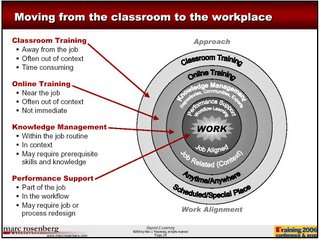
Training organizations need to rethink their delivery models to aim at providing support for work in the context of work.
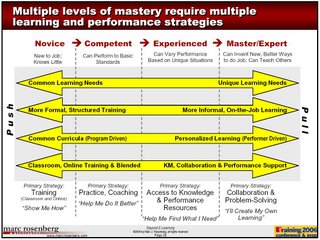 As expertise increases, we need to provide very different kinds of tools.
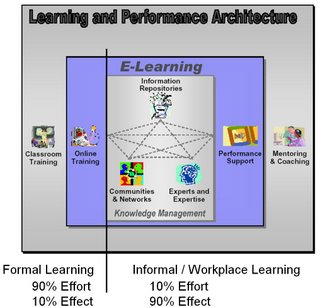
Yet when you look at where we spend our time and effort in most training organizations it focuses on solutions that are inherently aimed away from the work and towards novices.
Good Stuff Marc!
P.S. I annotated this last diagram with some comments he made during the session but that were not on his slies.
Marc's session on Beyond eLearning (PDF) was pretty interesting. It covers some of the same ground as previous presentations by Marc and a recent article - What Lies Beyond e-Learning?
But I like the following points he's making and these were certainly being reinforced in other sessions including mine on Blended Learning.

Training organizations need to rethink their delivery models to aim at providing support for work in the context of work.
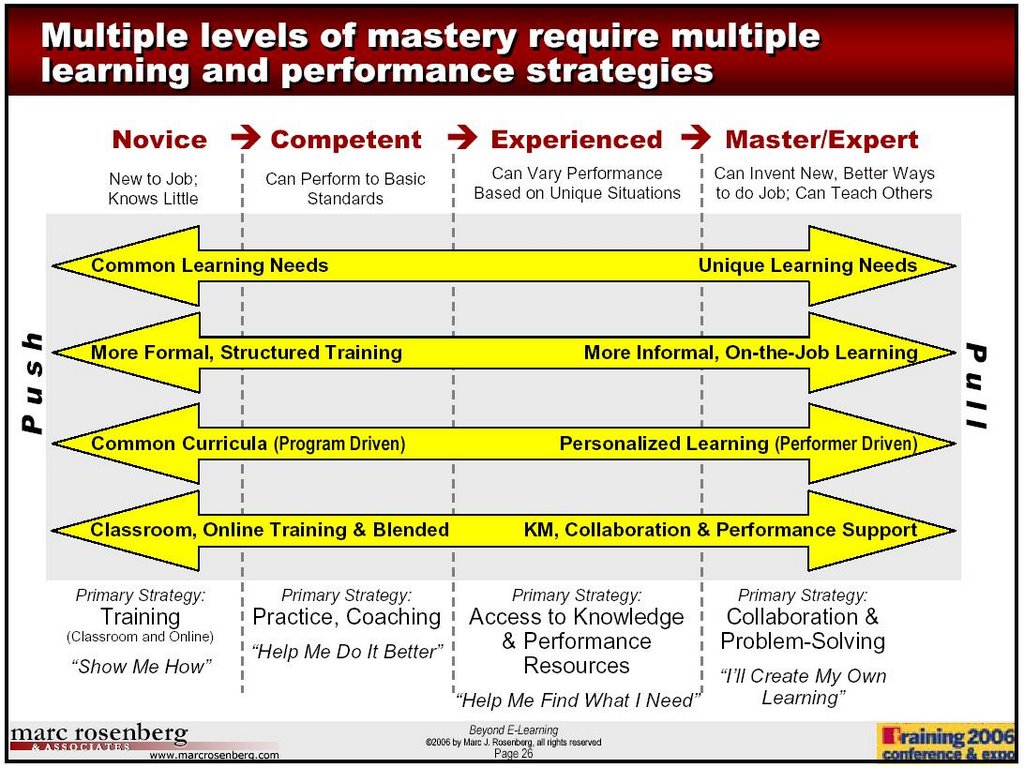 As expertise increases, we need to provide very different kinds of tools.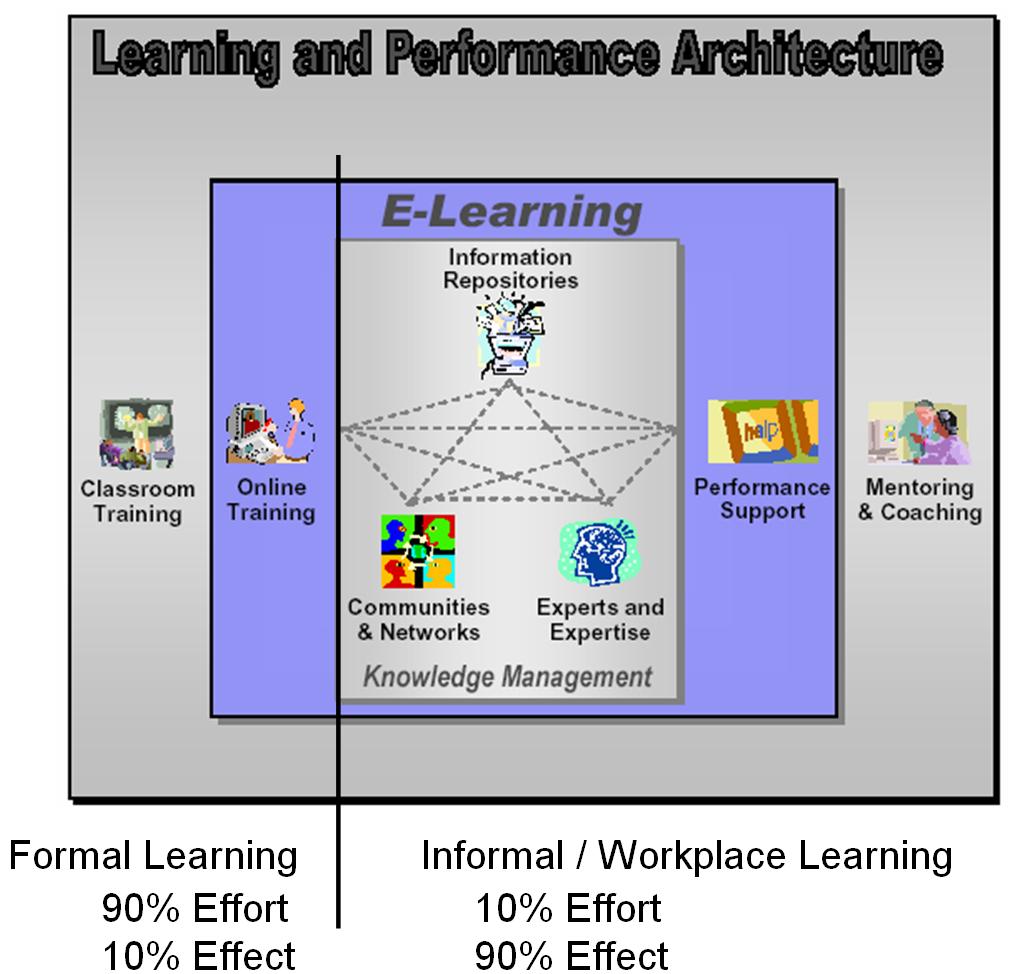
Yet when you look at where we spend our time and effort in most training organizations it focuses on solutions that are inherently aimed away from the work and towards novices.
Good Stuff Marc!
P.S. I annotated this last diagram with some comments he made during the session but that were not on his slies.
Friday, March 03, 2006
Blended Learning Composition
One of the more interesting recent developments in Blended Learning are new approaches that are emerging to address the classic problem of how to compose your blend together into a seamless, trackable learning experience. LMS products have been generally done a very poor job of this, mostly allowing you to list all the different elements of the blend.
As background, take a look at LAMS and particularly the demonstrations. The description of LAMS in their FAQ is interesting:
As background, take a look at LAMS and particularly the demonstrations. The description of LAMS in their FAQ is interesting:
LAMS is focussed on a very specific aspect of e-learning – sequences of learning activities, particularly collaborative activities. LAMS provides rich functionality for designing a “flow” of learning activities, especially where these activities rely on collaboration between students to drive the learning process. LAMS is a comprehensive system for the design and implementation of learning activity sequences – it includes an authoring environment, a “run-time” environment for implementation of sequences with groups of learners, and a monitoring environment so teachers can see student progress in real-time (and view past activities). It also includes a user administration system for system administrators. LAMS can include content delivery (and quizzes) as single-learner activities within a sequence, and you can point to content held elsewhere from within a LAMS sequence via a URL.
However, LAMS does not attempt to replicate the course administration functionality of a typical LMS/VLE/CMS.

You can see a sample flow above. Essentially, LAMS allows the specification of a blended learning sequence via a workflow diagram. Very interesting concept.
It's also worth looking at what Michael Feldstein and Patrick Masson are doing around an LMOS.
In the corporate space, probably the closest thing comes from Bill Bruck at q2Learning.
All of these aim at the need of being able to compose together a variety of intervention types into a Blended Learning solution. The LAMS approach is good to look at, because it looks like the workflow problem that this really is.
I think its pretty safe to assume that the big corporate LMS vendors will jump on this bandwagon soon enough by adding a workflow tool into their systems to finally be able to support richer specifications of blended learning programs.
I definitely have some concerns here with the direction that folks are taking, but more on that later...
Subscribe to:
Posts (Atom)